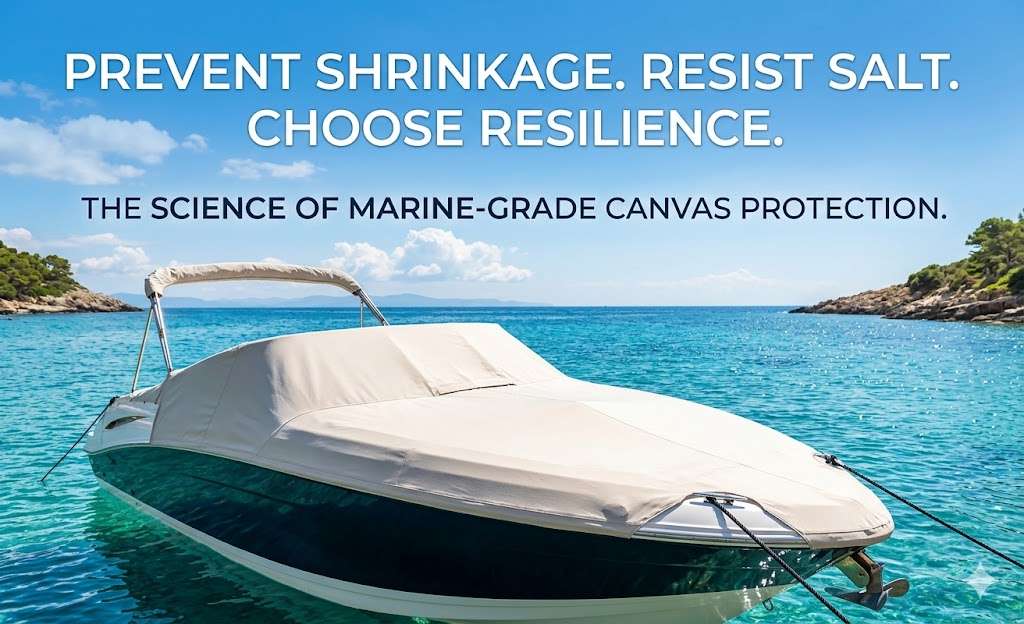
If you’ve ever had a boat cover that started fitting loose after a year, or noticed white crystalline buildup on your canvas, you’ve experienced two silent killers: shrinkage and salt damage. Most boat owners don’t understand why these things happen—and that’s exactly why so many covers fail prematurely. Below, we’ll talk science, and then solutions.
Why Canvas Shrinks
Canvas isn’t inert. Cotton fibers (or synthetic blends) form its structure, and those fibers respond to moisture, heat, and UV exposure. When water and heat cycle through your canvas repeatedly—which happens 365 days a year if your boat is moored outdoors—the fibers naturally contract.
It’s not visible at first. However, after season one, you notice the cover isn’t as snug. By year two, water is pooling in the low spots. Pooling water accelerates the shrinkage cycle, and suddenly you’ve got a problem: a loose cover that flaps in the wind, collects debris, and lets moisture under the edges.
Pro tip: Shrinkage is preventable, but not with cheap canvas. Premium marine canvas is pre-shrunk and treated to resist moisture absorption in the first place.
The Salt Damage Silent Treatment
If you moor in saltwater, you’re fighting a different enemy: sodium chloride. Salt spray doesn’t just land on your canvas. It settles into the fibers and the stitching. Over time, it causes serious damage that compounds season after season.
Specifically, salt exposure:
- Breaks down fabric fibers at a microscopic level
- Corrodes the metal grommets and hardware that hold the cover in place
- Creates white crystalline deposits that look like mold but are actually corrosion
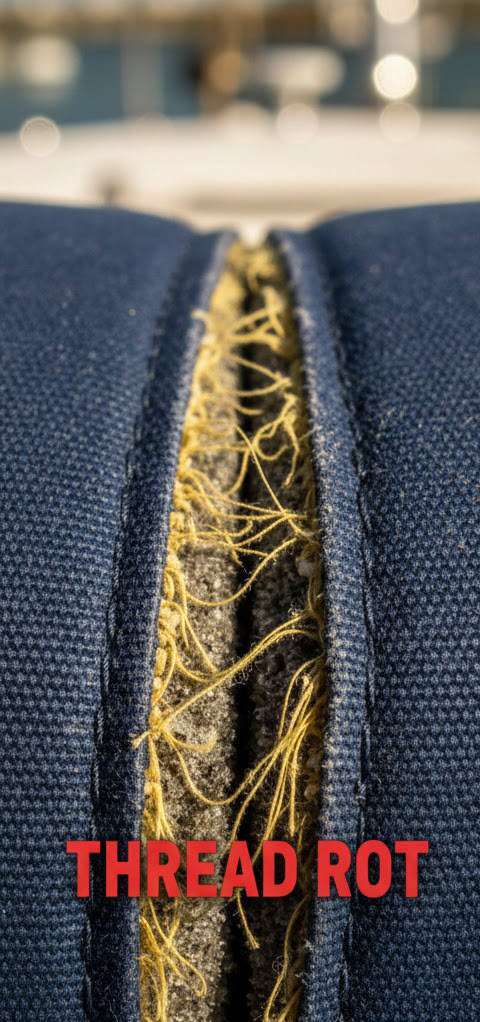
- Weakens stitching until seams separate
In more than a few cases, we’ve seen boats where the salt damage was so severe that the cover literally disintegrated when touched. And the boat underneath? By then the damage had already taken hold—hardware destroyed, paint ruined, interior fading.
How Professional Canvas Resists Both
This is where the engineering matters. Not all manufacturers build canvas the same way, and the difference shows up years down the line.
Pre-treatment and coating: Marine-grade canvas receives a salt-resistant coating that forms a barrier against sodium chloride. It’s not foolproof—nothing is in a saltwater environment—but it dramatically slows degradation.
Pre-shrunk construction: Manufacturers pre-shrink professional canvas before fabrication so the finished cover maintains its fit through repeated wet-dry cycles. Additionally, engineers optimize the weave density to resist moisture absorption rather than merely repel surface water.
Reinforced hardware: Williams Quality Covers uses corrosion-resistant materials for all marine-grade grommets and snaps. For example, stainless steel or solid brass hardware won’t pit and fail the way standard hardware does in a saltwater environment.
The Bottom Line
Canvas shrinkage and salt damage aren’t mysteries. They’re predictable, preventable, and manageable—but only if you start with the right canvas and the right design. Your boat’s canvas is the barrier between your investment and the ocean. Shouldn’t it be worth getting right?
So, if you have questions about your current cover or want to talk through a custom solution, reach out today. We’ll give you honest advice on what your boat actually needs—no sales pressure, just straight answers.
Get in touch today—we’re here to help your boat stay protected.