
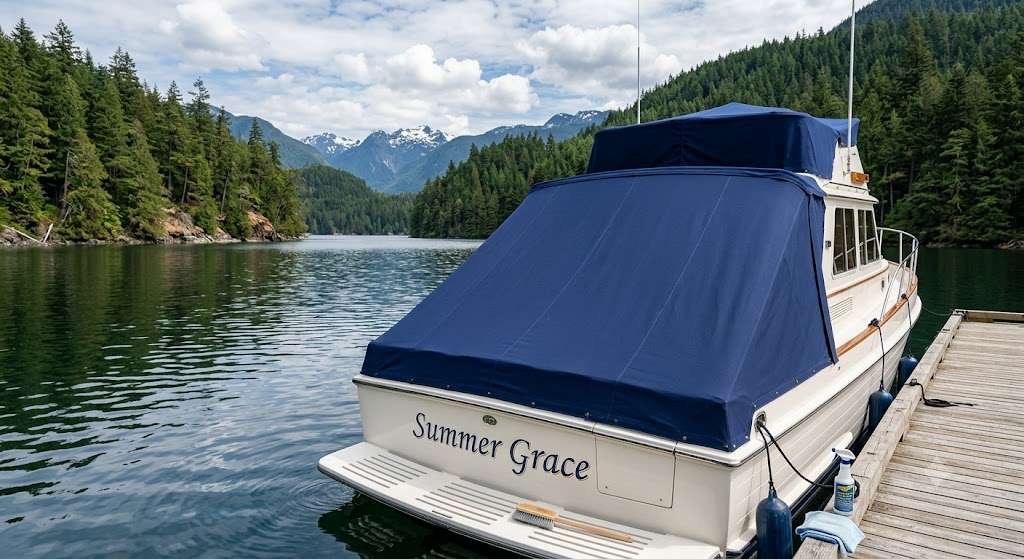
You’re a couple months into boating season. Your boat’s seeing regular use. The sun’s relentless. Salt water’s doing its thing (if you’re coastal). It’s at this point you start thinking about the importance of Canvas cover UV protection to help prolong the life of your boat’s covers.
And your canvas cover? It’s working harder than you probably realize.
Summer is when canvas covers take the most punishment—intense UV, thermal expansion from heat cycles, salt spray buildup, and the constant flex from covering/uncovering your boat for trips out on the water.
Implementing proper canvas cover UV protection is not optional—it’s essential for anyone serious about extending their boat cover’s lifespan. Without adequate canvas cover UV protection, your investment will deteriorate much faster, leaving you with expensive replacement costs.The Importance of Canvas Cover UV Protection
The good news: Mid-season maintenance is simple. But it has to happen now, not when you notice a problem in August.
Here’s what summer canvas covers actually need, and how to catch small issues before they become expensive ones.
What Summer Does to Canvas Covers (In Real Time)
Your cover isn’t sitting in storage anymore. It’s working. And that means:
- UV degradation accelerating – The sun is strongest in June-August. Unprotected canvas fades, brittles, and weakens faster than any other season.
- Thermal stress – Covers heat up to 140°F+ on sunny days, then cool quickly when covered or in shade. Constant expansion/contraction stresses seams and hardware.
- Salt accumulation – If you’re saltwater mooring, salt spray collects daily. It’s invisible until it corrodes hardware and hardens on the fabric.
- Moisture trapping – Humidity + covered boat + summer heat = condensation inside the cover. That’s mold waiting to happen.
- Hardware fatigue – Zippers, snaps, and fasteners flex constantly as the boat rocks, the cover expands/contracts, and you open/close it for trips. By mid-season, weak hardware is about to fail.
- Mildew development – Summer humidity creates perfect conditions for mold growth, especially in shaded areas or where airflow is poor.
The boats that have cover issues in August aren’t the ones with bad covers—they’re the ones that skipped maintenance in June.
The Mid-Summer Canvas Care Checklist (Do This Now)
1. Deep Clean Before Problems Start (2-3 hours)
This isn’t cosmetic. Dirt, salt residue, and debris hold moisture and accelerate degradation.
What to do:
- Remove loose debris – Brush off leaves, dirt, pollen with a soft brush (these trap moisture)
- Fresh water rinse – Hose down with fresh water to rinse salt spray and surface dirt. Don’t use pressure washer (too aggressive)
- Spot clean stains – Mix mild detergent with water; gently scrub any discoloration
- Pay attention to seams – Dirt loves seam lines; brush gently along all seams
- Dry completely – Let it air dry before re-covering the boat (at least 4 hours, ideally overnight)
- Check for mildew – If you see dark spots, see Problem #2 below
Why now matters:
- Salt hardens and becomes harder to remove the longer it sits
- Early mildew is easy to clean; late-summer mildew has penetrated deeper
- Clean covers don’t hide damage—you can see real problems instead of guessing
Cost: $0-20
Difficulty: Easy
Frequency: Every 3-4 weeks during summer (more often in saltwater)
2. Inspect for Mildew & Address Immediately (1-2 hours)
Summer humidity + covered boat = mildew heaven.
What to look for:
- Dark spots or discoloration (gray, green, or black)
- Musty smell when you uncover the boat
- Soft spots (mold has penetrated deeper)
- Interior moisture or visible dampness inside
If you catch it early (surface mildew):
- Clean with vinegar solution – 1 part white vinegar : 3 parts water
- Soft brush gently – Never scrub hard; you can damage the fabric
- Rinse thoroughly – All vinegar must be rinsed away
- Dry completely – This is critical; wet mildew just comes back
If mold smell persists after cleaning:
- There’s a deeper issue (water intrusion, poor ventilation)
- Call us – We can inspect and recommend actions
Why this matters:
- Surface mildew: $0 DIY fix
- Deep mold: $200-400 professional treatment + investigation
- Interior mold spreading to your boat: $3,000+ restoration
Cost: $0-15 (DIY) or $200-400 (professional)
Difficulty: Easy if caught early; complex if deep
Frequency: Check every 2 weeks
3. Hardware Check: Snaps, Zippers, Fasteners (30 minutes)
Heat and humidity cause metal fatigue. Failing hardware now prevents mid-August disasters.
What to check:
- Snaps – Open and close each one; listen for the click. Does it feel tight or loose?
- Zippers – Slide them fully open and closed 3 times. Do they stick, jam, or feel rough?
- Bolts/screws – Give each one a gentle tug. Any movement = it needs tightening
- Tie-downs – Make sure all straps are secure, no tears, no fraying
- Grommets – Look for cracks or loose rings around attachment points
If you find problems:
| Issue | DIY Fix | Cost | Difficulty |
|---|---|---|---|
| Stiff zipper | Silicone lubricant spray | $5-10 | Easy (30 min) |
| Loose snap | Tighten or replace | $10-30 | Easy-Medium (20 min) |
| Loose bolt | Tighten with wrench | $0 | Easy (10 min) |
| Torn snap hole | Reinforce or relocate | $50-100 | Call us |
| Broken zipper teeth | Replace zipper | $150-300 | Call us |
Cost: $0-30 (DIY quick fixes)
Difficulty: Easy
Frequency: Every 2 weeks during summer
4. Seam Inspection: The Early Warning System (15 minutes)
Seams are where failures start. Summer heat stresses them more than any other season.
What to look for:
- Thread separation – Are threads pulling away from the fabric?
- Water stains – Marks along seam lines indicate water’s getting through
- Gaps forming – Any visible space between stitches or where panels meet?
- Fraying – Loose threads around seams (early warning sign)
What you can do:
- Trim fraying threads (doesn’t fix the problem, but prevents spread)
- Document with photos – Send us images; we can advise if it’s urgent
Red flags that need professional attention:
- Visible gaps in seams (not just threads)
- Water marks inside the cover near seams
- Separation that’s growing (check weekly)
Cost: $0 DIY observation, $150-300 professional if needed
Difficulty: Easy to inspect, professional to fix
Frequency: Every 2 weeks
5. Ventilation Check: Preventing Internal Condensation (10 minutes)
The #1 cause of mid-summer mildew is trapped moisture, not rain leaks.
What to check:
- Vent openings clear? – Nothing blocking air circulation
- Interior damp or dry? – Quick peek inside when you uncover
- Smell fresh or musty? – Your nose is a good mold detector
If you’re seeing condensation/dampness:
- Improve airflow – Don’t cover boat completely; crack it open for ventilation
- Use desiccant – Moisture-absorbing packets inside help capture humidity
- Plan partial uncovering – On hot days, let it breathe for a few hours
This matters because:
- Trapped moisture inside the cover = mold on interior
- Mold on interior = mold spores inside your boat
- Those spores damage upholstery, electronics, interior finishes
Cost: $0-30 (if you use desiccant packets)
Difficulty: Very easy
Frequency: Every trip out
Summer Maintenance Schedule (What to Do When)
Every 2 weeks:
- Visual inspection (seams, hardware, discoloration)
- Check for mildew smell
- Test zippers and snaps
- Ensure ventilation is working
Every 4 weeks:
- Fresh water rinse to remove salt/dirt
- Spot clean any stains
- Detailed seam inspection
- Hardware tightening if needed
Immediately if you notice:
- Visible gaps or seams pulling apart
- Water stains inside the cover
- Persistent mildew after cleaning
- Hardware failure (snap won’t stay closed, zipper jams
Common Summer Mistakes That Cause Cover Failure
Mistake #1: Skipping rinses to save time
- Salt accumulates and hardens
- Hardware corrodes faster
- You’re setting up problems for September
Mistake #2: “I’ll just cover it up” (ignoring mold)
- Surface mildew becomes deep mold in 2-3 weeks
- What costs $0 to clean now costs $300+ later
- Clean immediately
Mistake #3: Leaving it soaking wet after rain
- Yes, covers are waterproof, but internal condensation is the real issue
- Dry it after rain events
- This takes 2 hours, prevents weeks of mold problems
Mistake #4: Ignoring hardware clicks/pops
- Snap feels different? It’s failing
- Zipper sticks once? It’s next
- Fix it NOW; don’t wait for total failure mid-trip
Mistake #5: Using harsh cleaners
- Pressure washers damage canvas
- Bleach weakens fabric
- Stick to mild detergent and soft brush
When Canvas Cover UV Protection Fails: Red Flags
Call immediately if:
- Seam gaps are visible – Not just thread fraying, but actual gaps forming
- Water is pooling inside – Means ventilation is failing or there’s a leak source
- Zipper completely jams – Not just stiff, but stuck
- Mildew returns within a week of cleaning – Indicates water intrusion problem
- Multiple snaps/fasteners are failing – Points to stress or damage issues
- You hear ripping sounds – Fabric tearing under wind or weight
Why summer timing matters:
- Small issues get WORSE in July-August heat
- August failures = emergency calls (we get busy, can’t get you in quickly)
- Mid-season repair now = prevention of September disaster
The Two-Minute Prevention Test
Every time you uncover your boat, do this quick check:
- Smell test – Musty? (See Problem #2)
- Visual scan – Any visible damage, gaps, or wet spots?
- Hardware click – Listen to snaps closing; feel zippers; tug ties
- Seam check – Any visible gaps or thread separation?
- Interior peek – Dry or damp inside?
Takes 2 minutes. Saves you $500+ in problems.
Summer Canvas Care Shopping List
To prevent mid-season issues, have these on hand:
- Soft-bristle brush ($5-10)
- Mild detergent (dish soap you already have)
- White vinegar (already in your kitchen)
- Silicone spray lubricant ($8-12)
- Desiccant moisture packets ($10-15)
- Snap replacement kit ($15-25) – just in case
- Soft cloths (old towels work)
Total investment: $50-80 in prevention.
Compare that to:
- Zipper replacement: $150-300
- Seam repair: $200-400
- Mold treatment: $200-500
- Full cover replacement: $2,500-10,000
Prevention is 90% cheaper than reaction.
Why Mid-Summer Matters More Than You Think
Your cover is at peak stress right now:
- Hottest months (UV damage accelerates)
- Humidity is highest (mold risk is peak)
- Hardware fatigue is maximum (metal’s been flexing for 3 months)
- Saltwater exposure is relentless (if you’re coastal)
The covers that fail in August aren’t the ones with manufacturing defects—they’re the ones that got skipped maintenance in June and July.
The ones that sail through September strong? Those owners did the simple stuff right now.
Your Mid-Summer Action Plan
This week:
- Deep clean your cover (2-3 hours well spent)
- Inspect seams, zippers, snaps, hardware
- Check for mildew
- Ensure ventilation is working
Every 2 weeks through August:
- Quick visual inspection
- Fresh water rinse if in saltwater
- Hardware tightening
- Mildew smell check
Before you put it away in fall:
- Full professional inspection
- Address any mid-season issues that lingered
- Plan any off-season repairs
Need Help This Summer?
Found an issue? Not sure if it’s urgent? Send us a photo.
We can tell you:
- If it’s DIY-fixable
- How urgent it is
- What it’ll cost if you bring it in
- Whether you should keep using your boat or address it first
→ Send Us a Photo for Assessment
Or book a mid-season inspection:
→ Schedule Summer Canvas Check-Up
And stock up on summer maintenance supplies: